Ventilation
Environmental Protection Agency
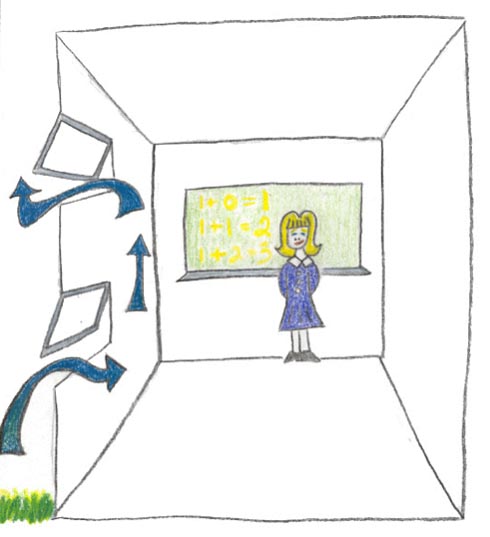
Ventilation refers to the exchange of air inside buildings with the air outside.
If you ever visit an old castle or mansion in England, I mean a really old one, you will see that people understood something about indoor air quality a long time ago. Take a look at the kitchens. They have very high ceilings with vents at the top. They knew that smoke and heat rose to the ceilings. If the ceiling was high enough and if it had a vent at the top, heat and smoke would rise, go out the vents and cool fresh air would come in through doors or windows near the ground. This kind of passive ventilation makes use of a principle called convection. Convection refers to the movement of a fluid due to changes in its density due to temperature. In this case, the cooler air is more dense than the warmer air so the cooler air pushes in at the lower windows forcing the warm air up and out the upper windows or vents. It's free and effective. Do you think that modern designers remembered this?
We've been in schools with no mechanical ventilation, only windows. In a few of the schools you easily recognize the builders or designers who remembered the old ways. These folks provided windows which open at both the top and bottom and they even provided the window opening poles as well. In fact we've been in schools where the designer created a lever system in the window frame, so that opening the bottom window automatically opened the top window. These folks understood that passive ventilation can be inexpensive yet effective ventilation. Unfortunately we also see rooms with only bottom windows or windows in the middle of the wall and these must be wide open and the wind must be blowing to get any air exchange at all.
As important as bringing in cooler fresh air near the floor of the room is - allowing old warmer air to be vented-off near the ceiling is also very important. This is especially true in rooms with low ceilings where we can actually feel accumulated heat on our heads compared with cooler air at our feet. As we said before, it's cheap and effective. The only drawback is that windows do not filter the air, remove humidity nor adjust the air to a specific temperature. For that we need mechanical ventilation.
Mechanical ventilation generally includes a heating system. Systems which also include air conditioning are referred to as Heating, ventilation and air conditioning or HVAC systems. In the old days, such systems included filters which were mainly to prevent the heat exchange components from clogging and losing efficiency. These old filters were referred to as "bug-catchers" since they really only caught large bugs and leaves. More modern systems include better filters to remove very small particles – the objective being to protect the equipment AND the occupants.
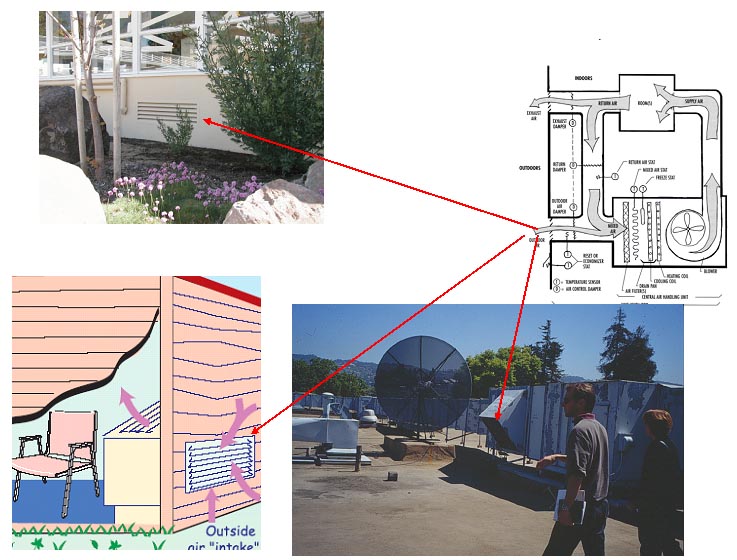 Well designed HVAC systems provide good temperature control, humidity control, control of air particles and they provide one more important thing – outside air. HVAC systems in public buildings such as schools, are required by state ventilation code to provide 15 cubic feet per minute (cfm) of outside air, per person, constantly while the room is occupied. For this to occur, two conditions must exist: (1) the outside air intake vent in the duct system must be open sufficiently; and (2) the fan or blower must be on continuously. We often find that neither of these conditions exist.
The maintenance staff is often reluctant to open outside air intakes because, to their credit, they are trying to save energy and it seems wasteful to allow heated or cooled air to escape. However, this is necessary in order to flush air pollutants from the building. Additionally, because HVAC units are often undersized for extreme climates, they can't properly control temperature when very hot or cold outside air is introduced. In that case, one understands the need to reduce outside air introduction, but when the season is more temperate, outside air intakes must be opened.
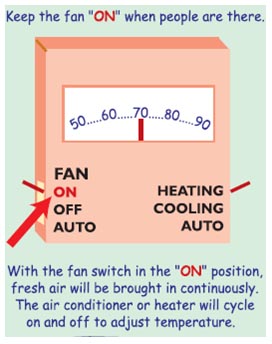 Another problem with providing outside air constantly is found in the ventilation controls. Ventilation controls have two switches, one controlling the heater or air conditioning compressor, and one which controls the blower. Generally, the manufacturers provide three settings for these switches. The heater and air conditioner are controlled by a switch which can be set to HEAT, COOL, AUTO. Usually, one would set these to HEAT in the winter, COOL in the summer and AUTO in Spring or Fall when you might want heating or cooling depending on the individual day. The blower can be set to ON, OFF, AUTO and this could lead to some confusion because the blower works in conjunction with the heating/cooling system.
When the blower is set to OFF, clearly no air will move and it won't matter where the heating/cooling switch is set. AUTO sounds like a good place to set the switch but not really. In the AUTO position, the blower will shut down when the thermostat says that the temperature is at the desired level. If the blower shuts down, no air will move at all therefore you won't get that continuous introduction of outside air which is required by ventilation codes. In California, where the weather is often just right, there may be many hours of the day when no air is moving at all and indoor pollution will accumulate. Thus, the proper setting for the blower is ON. In this position, air will constantly move, new air will be drawn in and the heating/cooling system will cycle on and off as called for by the thermostat. We often see ventilation controls set to AUTO and the room is very stuffy.
Well this all sounds good, but that ain't the way things always happen. The controls described above are often found in portable classrooms and sometimes in the other classrooms. It's not unusual, however, to find lock-boxes around the controls or no controls whatsoever. The maintenance staff do not like teachers to have access to controls because without proper instructions, teachers frequently move switches and thermostat settings all over the place which messes up the temperature and results in calls to the maintenance department. It's easier just to lock the teachers out of the controls or have temperature sensors in the room with the controls operated by computers at the maintenance office. The effect of this however, is an adversarial relationship between the teachers and the maintenance staff. Consider what would happen if the government locked you out of your home heating system! Generally, educating teachers about their HVAC systems and providing proper instructions are the better way to go to assure a cooperative relationship.
Another issue with HVAC systems is noise. It's difficult if not impossible to teach over a noisy HVAC system. There's no point in telling a teacher that the ventilation code requires the system to be on constantly if he or she can't teach. We find it better to explain that the system provides fresh air when it's on and ask the teachers to remember to turn it back on when they're not lecturing. Of course this can work only when teachers have access to controls. So noise becomes not only a teaching/learning issue, it is also an indoor air quality issue.
Unfortunately, because of theft and building fads, schools have been designed with HVAC systems and windows which don't open or no windows whatsoever. This is an "all your eggs in one basket" problem. If you're totally dependent upon mechanical ventilation, then it darn-well better work properly all the time. Any problem with the system can result in uncomfortable conditions which may become unhealthful and unproductive.
Another problem with mechanical ventilation in schools is that there is often a multitude of different systems throughout the district; we often find different systems in one school. This makes it difficult for the maintenance director to keep an adequate supply of spare parts. Consequently it's not uncommon to have to wait to even begin repairs until parts arrived.
Some no-cost / low-cost suggestions for improving air quality
 Make sure that windows which were made to open – can be opened, including upper windows.
- If you don't have window opening poles – get them.
- Do not block windows with cabinets or posters.
- Window blinds should be operable so that they can be opened and not block air flow.
- Identify where ventilation systems bring in outside air. Make sure that outside air vents are open.
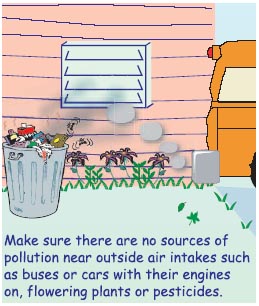
- Make sure that outside air intakes are protected, i.e. free of sources of pollution.
- Make sure outside air intakes are not blocked by landscaping. Are there flowering plants near these vents?
- Make sure that the fan or blower for the ventilation system is ON all the time. Place a little steamer near your vents. The streamers should indicate that air is moving all the time.
- Learn how to operate ventilation controls.
- If you must turn off ventilation systems because of noise, remember to turn them back on when you're not lecturing.