Improving the Air Quality in Your Own School: What YOU Can Do!
U.S. EPA / Region 9
Poor air quality, whether outdoors or inside, is a serious issue. Improving the quality of our air outdoors is a complex issue but improving it indoors is often just a matter of recognizing how our typical activities affect IAQ. A little education goes a long way; it's a matter of recognizing how we contribute pollutants and how we often prevent their removal.
The difference between the outdoor environment and the indoor environment is that the outdoor environment is big and the indoor environment is small. Release a pollutant outdoors and it gets diluted quickly or blows away - unfortunately to some inland city. Release a pollutant indoors and it just hangs around - unless we engineer our buildings to remove them. This engineering ranges from simply installing open-able windows to designing a complex ventilation system which brings in outside air, filters the air, adjusts the humidity of the air and possible even sterilizes the air.
First we have to recognize how we contribute pollutants to our indoor environment. The best place to begin is with our own bodies. Living beings are constantly releasing gases, skin cells and moisture as a part of our metabolism. Bacteria live on us and in us and they have their own metabolism as well so they're also contributing to our indoor environment. So right there we've got enough reason to be concerned with exchanging some inside air with outside air, but of course, there's more.
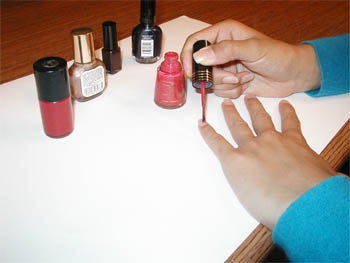
Since the result of all this metabolism is usually body odor, we usually use deodorants directly on our bodies and then use room air "fresheners." All of these odor remedies are just adding more chemicals to our air and should not be considered to be improving our IAQ. Hence, applying deodorants and using air "fresheners" are two typical activities which contribute pollutants to our air. Consider the "fresheners" we add to our clothing during washing and drying and we have another pollutant-contributing activity.
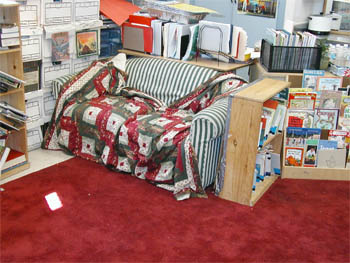
Next we should consider what we do inside classrooms. In order to change a rather bare classroom into a warm and nurturing environment for children, we bring in furnishings and floor coverings which trap dirt and dust and allergens and given a little dampness, invite mold and bacteria to take-up residence. Bring in some snack food and we send out an invitation to insects and rodents. Battle the insects and rodents with pesticides and there you go again, adding more to indoor environment. "Clean" the indoor environment with an arsenal of products in order to make your room more healthful and - guess what - you may have accomplished just the opposite. Vacuum to get the big pieces off the floor and suck-up all the very fine particles which weren't bothering anyone while on the floor and then blow them right into your breathing zone. Sheesh!
Our basic building materials often off-gas components of glues, preservatives and plastics and make their own contribution to the air we breathe. Then we do art and science activities and we continue to contribute. Shampoo rugs, strip and wax floors and it's amazing that we can even see through the air in our classrooms. While we're at it let's take a look at the pets we bring in and the allergens they contribute. Are you starting to get the picture? Once we start thinking about this, we open our eyes to the issue and begin to recognize where and how stuff gets into our air. Now let's look at how we often prevent removal of that stuff.
As we said in the second paragraph, pollution removal systems may be as simple as an open window or as complex as a sophisticated heating, air conditioning and ventilation (HVAC) system. Both of these systems exchange outside air with inside air and we want to do this because the air inside has accumulated all kinds of stuff from the activities described above. We say that indoor air is often more polluted than outdoor air. Air exchange, i.e. "ventilation" becomes very important.
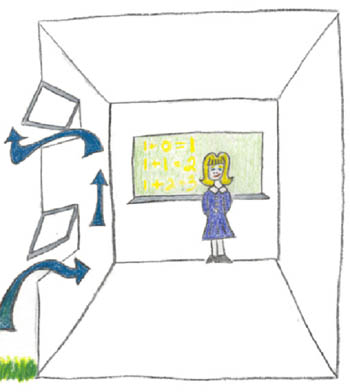
Opening a window seems simple enough. In fact opening a window often does not allow much air exchange. You can't get air into a room unless you also allow some to leave. Opening windows on both sides of a room, or a window and a door will allow this air movement better than just opening one window. Also, window systems consisting of open-able top and bottom windows allow convective circulation. Air is warmed by our bodies and room lighting and heating and rises to the ceiling. It accumulates and we can often feel that the air at head-level is warmer than the air at ankle-level. Opening top and bottom windows allows the warm air to leave through the top window and the cool air to enter the bottom window. We get wonderful circulation without using any energy.
Unfortunately, in schools with top and bottom-opening windows we often find that people do not understand the principle of convective circulation or the top window is just difficult to open. Either it's stuck, or the window-opening pole is missing or the shades prevent easy opening. With the understanding that opening the top window can dramatically increase ventilation, perhaps we can find the pole, repair the shades and un-stick the window. It really doesn't take much time and money and can achieve dramatic improvements in our IAQ. Understand it and bring it to the attention of your maintenance staff.
Mechanical ventilation systems require two things: (1) an understanding of how they work and how controls should be adjusted (if you have access to the controls); and (2) unobstructed vents. Ventilation controls consist of both a blower or fan control and a heating or cooling control. On the heating-cooling control, we have a HEATING and COOLING and AUTO setting. These are relatively clear. In the winter we'll want HEATING, in the summer we'll want COOLING and in the spring and fall, we may want AUTO so that the heater or air conditioner will come on as prompted by the thermostat. The fan control however, is a little different.
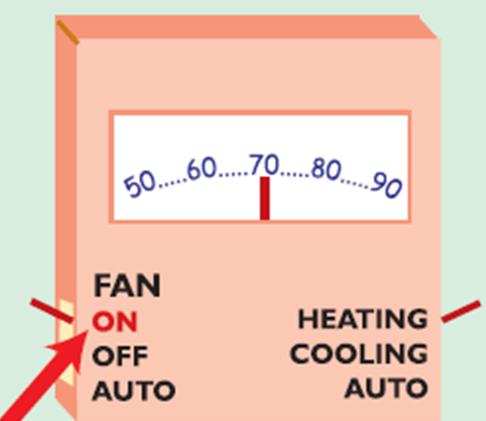
Fans controls usually have ON, OFF and AUTO settings. ON and OFF are relatively clear, but what does AUTO do? AUTO sounds good - we like things to be automatic - to take care of things for us without having to remember them - but not in this case. Clearly we don't want the fan set to OFF because we'll get no air movement at all. In the ON position the fan will run all the time and the heating and cooling units will cycle on and off as directed by the thermostat. However in AUTO, the fan will shut-off when the thermostat says that the temperature setting is achieved. When the fan shuts-off, no air moves and no inside air is exchanged with outside air. Hence, the fan control should always be set to the ON position; this is actually required by state ventilation code. Yes, we know they can be noisy and sometimes uncomfortable, but at least understand that this is the way they SHOULD be operated.
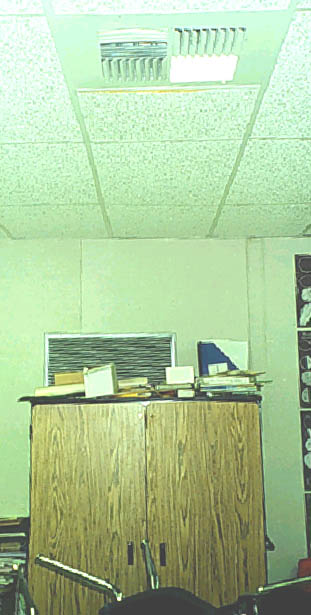
Then there are the vents. Not only do we have vents that blow, we also have vents that suck - and both of these need to be unobstructed. Learn where all the vents are and what they do and keep the books and art work away from them. And it's not good enough to leave an inch of space between the intake vent and the file cabinet, that won't allow sufficient air flow. Actually this also goes for the thermostat controls which need to experience what the general room conditions are, not just the conditions behind the file cabinet. We often find the thermostat in the room by looking for bumps behind the posters. You want the thermostat to feel what you're feeling so unless you often hide behind the filing cabinet or poster - and I would really understand if you did - don't hide the thermostat behind them either.
So to sum it all up, think about what you're adding to the air and add less of it. Try to use unscented products or go easy on applying them. Don't just cover odors, remove odors by helping your ventilation system do its job. Arrange your classroom so that the custodians can do their job more quickly and efficiently. Avoid dust collectors. Use washable cushions or rugs. Minimize the number of pets and stick to district recommend cleaning products and minimize the use of these.
And go to: http://www.teachersforhealthykids.com/images/uploads/IAQ%20Poster%20Example.pdf for the California Teachers Association's poster "Improving Your IAQ IQ."

One more thing: implement the EPA's IAQ Tools for Schools program at your school: http://www.epa.gov/iaq/schools/index.html. Please call or email me at 415-947-4193 / rosenblum.shelly@epa.gov for more information. Students can and should be involved.
Thanks for doing what you do and please call upon me to help you do it!